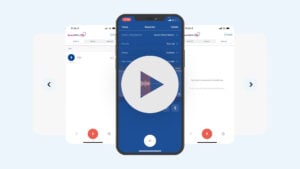

What is Ambient AI?
Ambient AI is artificial intelligence that works quietly in the background of a clinical consultation. Instead of asking a clinician to type notes, dictate separately, or rebuild the record after the appointment, Ambient AI can listen to the clinician-patient conversation and produce a structured draft note, letter, summary or workflow output for review.
In healthcare, Ambient AI is often described as an ambient scribe, AI scribe, ambient clinical documentation tool or advanced ambient voice technology. The terminology varies, but the core idea is consistent: speech recognition captures the conversation, natural language processing interprets it, and generative AI helps turn it into usable clinical documentation.
The word “ambient” is important. Good Ambient AI does not sit in the middle of the consultation demanding attention. It supports the encounter from the background, allowing the clinician to keep their focus on the patient rather than the keyboard.
For clinicians, the promise is less time spent on low-value administration. For patients, it can mean more eye contact, better listening and a less screen-led consultation. For healthcare organisations, it can improve documentation quality, workflow efficiency and the productivity of clinical teams.
Why Ambient AI matters now
Healthcare has a documentation problem.
Clinical records are essential. They support safe care, continuity, coding, referrals, audit, governance and legal accountability. But the volume of documentation expected from clinicians has grown to the point where it can compete with the act of care itself.
Many clinicians now spend substantial time recording, correcting, formatting and completing notes. Some of that happens during the consultation, where it can affect eye contact and conversation. Some happens between appointments or at the end of the day, extending work into evenings and contributing to burnout.
Ambient AI is gaining attention because it changes where documentation work happens. Instead of asking clinicians to reconstruct the consultation afterwards, Ambient AI captures the conversation as it happens and turns it into a structured draft. The clinician still reviews, edits and approves the output, but the starting point is already prepared.
That shift matters. It means the clinical record can be created closer to the point of care. It reduces reliance on memory after a busy clinic. It can also reduce the friction between speaking with a patient and producing a useful, accurate record.
In practical terms, Ambient AI can support consultation notes, referral letters, patient letters, discharge summaries, coding prompts, action lists, follow-up tasks, structured data capture and electronic patient record updates.
The strongest use cases tend to be conversation-heavy settings where documentation is detailed and time-consuming. That includes primary care, outpatient clinics, mental health, community care and hospital specialties where patient conversations generate substantial clinical records.
How Ambient AI works in a consultation
Although products differ, most Ambient AI workflows follow a similar pattern.
First, the clinician activates the approved Ambient AI tool in line with the organisation’s policy and consent process. The system captures the conversation through a secure device, app, browser or integration within the clinical system.
Second, the audio is transcribed. Speech recognition turns spoken words into text, while more advanced systems may distinguish speakers, recognise medical vocabulary and handle different accents or speaking styles.
Third, the AI interprets the transcript and organises clinically relevant information into a structured output. Depending on the product and configuration, this may follow a SOAP format, specialty template, problem-orientated note, referral format or local documentation standard.
Fourth, the clinician reviews the draft. This is essential. Ambient AI should support clinical judgement, not replace it. The clinician remains responsible for checking accuracy, adding missing context, correcting errors and approving the final record before it is saved or integrated into the electronic patient record.
This is what separates Ambient AI from traditional dictation. Dictation converts speech into text. Ambient AI listens to a natural consultation and produces structured documentation from it. That difference is why it has such potential for clinicians, patient care and productivity.
The impact of Ambient AI on clinicians
For clinicians, the biggest benefit of Ambient AI is relief from administrative load.
Clinicians do not object to documentation because records are unimportant. They object when documentation interrupts the clinical relationship, extends the working day and adds mental strain. Ambient AI targets that problem directly.
One of the clearest impacts is reduced cognitive load. During a consultation, clinicians are already managing symptoms, risk, history, uncertainty, rapport, medication, investigation choices and shared decision-making. Trying to document everything at the same time adds another task. Ambient AI can reduce that split attention by allowing the clinician to speak naturally and review a draft afterwards.
It can also reduce the work that follows clinicians home after clinic. When notes are drafted closer to the consultation, clinicians are less likely to carry a growing backlog of unfinished records through the day. That can support better work-life balance and a more sustainable clinical workload.
Recent evaluations of ambient documentation technology have reported improvements in clinician experience, documentation burden, cognitive load and burnout measures. The evidence is still developing, and results vary by specialty, workflow and implementation quality, but the direction is important. Ambient AI appears most useful where notes are detailed, consultations are complex and clinicians currently spend substantial time writing after the patient has left.
In practical terms, Ambient AI can help clinicians prepare more complete draft notes, reduce typing during the appointment, spend less time formatting records, capture patient wording more accurately, improve note completion times and focus more fully on diagnosis, treatment and communication.
There is also a workforce angle. When documentation pressure contributes to burnout, technology that reduces that pressure becomes a retention issue as well as a digital transformation issue.
That said, Ambient AI is not a magic fix. If the output is inaccurate, poorly integrated or difficult to edit, it can create new work. If clinicians are not trained properly, adoption will be uneven. The impact on clinicians depends on whether Ambient AI is implemented as a clinical workflow improvement, not simply bought as another digital tool.
The impact of Ambient AI on patient care
The patient benefit of Ambient AI starts with attention.
Patients notice when a clinician is looking at a screen. They notice when the consultation feels like data entry. They notice when questions are repeated because the clinician is trying to type and listen at the same time.
Ambient AI can improve the quality of the consultation by giving clinicians more freedom to maintain eye contact, listen actively and respond naturally. That does not mean the technology disappears entirely, but it can reduce the extent to which documentation dominates the room.
This is especially important in sensitive consultations. In mental health, oncology, palliative care, chronic disease management, safeguarding and complex diagnostics, the quality of conversation matters. A patient may disclose more, ask better questions and understand advice more clearly when the clinician is not constantly pulled back to the keyboard.
Ambient AI can also support patient care through better records. A good clinical note is the memory of the consultation for the next clinician, the multidisciplinary team and the wider patient journey. If Ambient AI helps capture fuller, more timely and more consistent documentation, it can improve continuity of care.
Better documentation can support safer handovers, clearer referrals, more accurate medication and problem lists, better follow-up planning, stronger audit trails and more useful patient letters.
Transparency still matters. Patients should understand when AI-enabled ambient scribing is being used, what it records, how the information is processed, who can access it and how the clinician will check the final output. Consent and trust are central to safe adoption.
There is also an equity consideration. Ambient AI systems must work well across accents, dialects, speech patterns, clinical specialties and patient groups. Healthcare organisations should monitor accuracy and usability across real populations, not only during controlled demonstrations.
Used carefully, Ambient AI can improve patient care by reducing distraction, supporting better communication and strengthening the quality of clinical documentation. Used poorly, it risks adding uncertainty, privacy concerns or documentation errors.
The impact of Ambient AI on productivity
Productivity in healthcare should not mean rushing clinicians or forcing more patients through an already strained system. It should mean reducing waste, removing duplication and helping skilled staff spend more of their time on work that requires their expertise.
Ambient AI fits that definition well.
If a clinician spends significant time after each consultation completing notes, and Ambient AI reduces that burden, the organisation gains capacity. That capacity might be used to see more patients, reduce waiting times, complete administrative work sooner, improve same-day communication or simply make existing workloads more sustainable.
The productivity case for Ambient AI usually appears in five areas. Documentation turnaround improves because notes can be drafted immediately after the consultation. Administrative rework can fall because structured notes, letters and summaries are created closer to the source conversation. Coding and data quality can improve when information is captured consistently. Clinical flow may improve where documentation is the bottleneck. Integration can also reduce friction by moving approved outputs into the electronic patient record without unsafe copy-and-paste workarounds.
The impact will not be identical everywhere. A GP seeing short, high-volume consultations may experience Ambient AI differently from a psychiatrist writing long narrative notes or a consultant preparing complex outpatient letters. Organisations should measure Ambient AI in the context of the work being done.
Useful metrics include time spent in notes per appointment, after-hours documentation time, note completion time, clinician satisfaction, patient experience, documentation quality, correction rates, specialty adoption and referral or letter turnaround.
Ambient AI productivity should be proven in the workflow, not assumed from the sales pitch.
Ambient AI, safety and governance
Ambient AI can support safer care, but only if it is treated as a clinical system with real risk controls.
The most obvious risk is output error. An Ambient AI tool may omit information, misunderstand context, summarise too aggressively, insert incorrect details or use wording that changes clinical meaning. It may struggle with overlapping speech, background noise, medication names or complex consultations.
That is why clinician review is non-negotiable. Ambient AI should produce a draft, not an automatically finalised clinical record. The clinician must validate the note before it becomes part of the patient record or triggers further action.
Safety also depends on clear scope. Some Ambient AI tools generate draft notes. Others may suggest codes, tasks, referrals or follow-up actions. The more the system influences downstream workflow, the more carefully it needs to be assessed, governed and monitored.
Healthcare organisations should consider clinical safety cases, hazard logs, data protection impact assessments, information governance approval, cyber security controls, supplier assurance, medical device status where relevant, EPR integration, audit processes, user training and incident reporting.
In the UK, NHS England has published guidance on AI-enabled ambient scribing products, including considerations for clinical safety, information governance, supplier assurance, regulatory compliance and integration. That guidance matters because Ambient AI is moving quickly, and local enthusiasm needs to be matched by structured assurance.
The principle is straightforward: Ambient AI can reduce burden, but it must not reduce accountability. The clinician remains the decision-maker. The organisation remains responsible for safe deployment. The supplier must provide appropriate evidence, controls and support.
What good Ambient AI implementation looks like
Successful Ambient AI implementation is not just a procurement exercise. It is a clinical change programme.
The starting point should be a clear problem statement. Is the organisation trying to reduce after-hours documentation? Improve clinic flow? Speed up letters? Support primary care workload? Improve outpatient note quality? Reduce duplication between systems? Different goals require different workflows, measures and success criteria.
Clinical leadership is essential. Ambient AI changes how clinicians consult, document and review records. It needs champions who understand the realities of the service, not only the technical features of the product.
Integration should be treated as a core requirement. If clinicians have to move between systems, copy text manually or correct formatting repeatedly, the productivity case weakens. Ambient AI should fit into the electronic patient record and the natural rhythm of care.
Training should be practical. Clinicians need to know when to use Ambient AI, how to introduce it to patients, how to review outputs, how to correct errors, and when not to use it. They also need clarity on consent, privacy and accountability.
Evaluation should be continuous. A small pilot may show enthusiasm, but organisations need to understand whether benefits persist at scale. Results should be compared across specialties, appointment types, clinician groups and patient populations.
Good implementation also recognises that Ambient AI will not suit every consultation. Some encounters may be too sensitive, noisy, brief or complex for the tool to add value. Clinicians should have discretion within a clear governance framework.
Final thoughts: why Ambient AI matters
Ambient AI matters because it tackles a problem at the heart of modern healthcare: clinicians are spending too much time serving the record and not enough time being supported by it.
By turning clinical conversations into structured draft documentation, Ambient AI can reduce administrative burden, improve the consultation experience, support better records and create meaningful productivity gains.
The opportunity is real, but it depends on thoughtful implementation. Ambient AI must be safe, governed, integrated and clinically led. It must support professional judgement rather than bypass it. It must earn trust through accuracy, transparency and measurable value.
Used well, Ambient AI is not just another healthcare technology trend. It is a practical way to give time and attention back to clinical care.