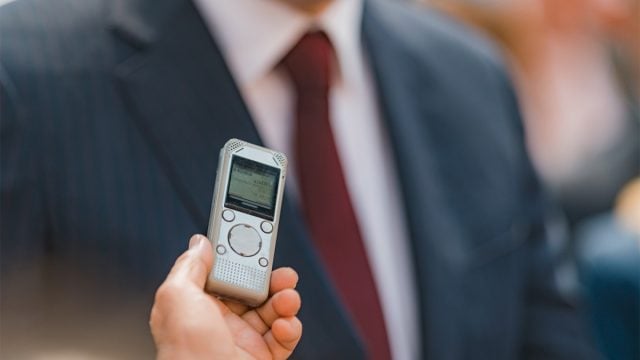
A dictaphone is a device for recording the spoken word so it can be played back and typed up later. The name is more than a century old, but the idea behind it still drives how busy professionals turn speech into finished documents. This guide explains what a dictaphone is, how it works, and why dictation has moved from tape to the cloud.
Key Takeaways – A dictaphone is a voice-recording device used to capture speech for later transcription; the word began as a brand name and became a generic term. – The technology traces back to Edison’s phonograph in 1877; the “Dictaphone” trademark was registered in 1907 (Wikipedia, Dictaphone, 2026). – Modern dictaphones are digital: they record to memory or the cloud instead of tape, and feed straight into transcription or speech-recognition software. – People still dictate because it’s fast: a Stanford study found speech entered text about three times faster than typing (Ruan et al., Stanford University, 2016).
What is a dictaphone?
A dictaphone is a portable device that records spoken words so they can be replayed and transcribed into text. The term covers everything from early wax-cylinder machines to today’s digital voice recorders and smartphone dictation apps. In short, if it captures your voice for someone (or something) to type up later, it’s doing a dictaphone’s job.
The word started life as a trademark and slipped into everyday English as a generic noun, much like “hoover” or “biro”. So when people ask what “dictaphone” means, they’re usually describing the function (recording speech for transcription) rather than one specific product.
Where the dictaphone came from: a short history
The dictaphone grew out of Thomas Edison’s phonograph, which he unveiled in 1877 as the first device able to record and replay sound (Encyclopaedia Britannica, Thomas Edison: The phonograph, 2026). Rivals soon adapted the idea for office use, and in 1907 the Columbia Graphophone Company registered the “Dictaphone” trademark, becoming the leading maker of dictation machines (Wikipedia, Dictaphone, 2026).
From there the recording medium kept changing while the purpose stayed the same. Wax cylinders gave way to grooved plastic Dictabelts in 1947, then to magnetic cassette tape after the Compact Cassette arrived in 1962 (IEEE Spectrum, How the Rivalry Between 2 Tech Giants Gave Rise to the Dictaphone, 2022). Today the medium is solid-state memory or the cloud, but you’re still doing what an Edwardian clerk did: speaking now, typing later.
How does a dictaphone work?
A dictaphone works in three steps: it captures your voice, stores it, and makes it available for transcription. A microphone converts sound into a signal, and the device saves that signal — on tape historically, on memory or the cloud today. You or a typist then plays it back to produce written text.
The core components are simple:
- A microphone to pick up speech, often with noise reduction so dense dictation stays clear.
- A storage medium, now usually internal flash memory or a secure cloud workspace.
- Playback and transfer controls, including the classic insert, rewind and overwrite functions a touch-typist relies on.
Modern digital recorders add one more step. They hand the audio straight to transcription or speech-recognition software, so the spoken words become editable text with little or no manual typing.
What are the different types of dictaphone?
Dictaphones come in a few recognisable forms, and the right one depends on how and where you dictate. The main types are handheld recorders, desktop devices and software apps, and each suits a different working pattern.
- Handheld recorders are the classic portable dictaphone: pocket-sized, rugged, and built for dictating on the move, in court, at a site visit or between meetings.
- Desktop dictation devices plug into a computer and are designed for fee-earners who dictate at their desk for long stretches, with hand controls for insert and overwrite.
- Smartphone and software apps turn a phone or PC into a dictaphone, recording straight to a secure app that syncs the audio for transcription.
In practice, the line between hardware and software has blurred. A dictaphone today is as likely to be an app on a solicitor’s phone as a separate device, but the job (clean speech capture for transcription) is identical.
Analogue vs digital dictaphones: what changed?
The difference between an analogue and a digital dictaphone is how the recording is stored and moved. An analogue dictaphone writes sound to a physical tape or belt that has to be carried, posted or hand-delivered to a typist. A digital dictaphone saves an audio file that can be encrypted, sent over a network and transcribed anywhere.
That shift matters for any document-heavy office. With tape, the recording was a physical object that could be lost, damaged or sat in an out-tray. With digital dictation, the file reaches the right person the moment you finish speaking, which is why most professional workflows have left tape behind. We cover that transition in detail in our guide to digital dictation.
Why do professionals still dictate?
Professionals still dictate because speaking is far faster than typing. A Stanford University study measured English text entry at about 153 words per minute by speech against 52 by keyboard, roughly three times quicker (Ruan et al., Stanford University, 2016). Specialist legal speech recognition makes the same claim: Nuance markets Dragon Legal as “3x faster than typing” (Nuance, Dragon Legal, 2026).
For a solicitor or partner billing by the hour, that speed gap is the whole point. Dictating a file note, attendance or letter takes a fraction of the time spent typing it. The recording can then be transcribed by support staff or software while the fee-earner moves on to the next matter.
From dictaphone to digital dictation workflow
The dictaphone hasn’t disappeared; it has become software. In a modern law firm, a fee-earner dictates into a handheld device or a phone app, and the audio is encrypted and routed to a secure workspace. From there it’s either typed by a secretary or turned into text by voice recognition. The recording never leaves a controlled, GDPR-aware environment.
That’s the version we build for UK law firms through our dictation solutions. The familiar habit of dictating stays; the tape is replaced by integrated, secure, AI-assisted transcription that drops finished text into your case or document management system. In our experience equipping firms, the fee-earners who adopt fastest already dictated to tape. The habit transfers cleanly; only the device changes. The skill the dictaphone taught generations of professionals still applies; only the plumbing behind it has changed.
Frequently Asked Questions
What does dictaphone mean?
Dictaphone means a device used to record spoken words for later transcription. It began as a trademark registered in 1907 and became a generic term for any voice-recording machine used to capture speech that someone will type up afterwards.
Is a dictaphone the same as a voice recorder?
In everyday use, yes. A dictaphone is a type of voice recorder designed specifically for dictation, meaning clear speech capture and playback controls like insert and overwrite. Any digital voice recorder can act as a dictaphone if it’s used to record speech for transcription.
Do people still use dictaphones?
Yes, though mostly in digital form. Lawyers and other document-heavy professionals still dictate daily. But the handheld tape recorder has largely been replaced by digital recorders, smartphone dictation apps and cloud-based systems that transcribe automatically.
What replaced the dictaphone?
Digital dictation replaced the tape dictaphone. Instead of recording to a cassette or belt, professionals now dictate into digital devices or apps. These create an audio file, encrypt it, and feed it straight into transcription or speech-recognition software.
Are dictaphones still used in law firms?
Yes. Dictation remains one of the fastest ways for fee-earners to produce attendance notes, letters and file notes. Most UK firms now use digital dictation rather than tape, routing recordings securely to support staff or speech-recognition software for transcription. — *Written by the SpeechWrite Editorial Team. SpeechWrite provides digital dictation, voice recognition and Ambient AI to UK law firms, integrating secure, GDPR-aware workflows with the case and document management systems firms already use.*